
Journal · Bookkeeper & Month-End
Why ecommerce accountants reject black-box dashboard numbers (and what makes an audit trail defensible)
An accountant cannot book a journal entry from a dashboard chart that hides how many orders it skipped. Here is why coverage gates, deterministic rules, and explicit uncertainty statements matter.
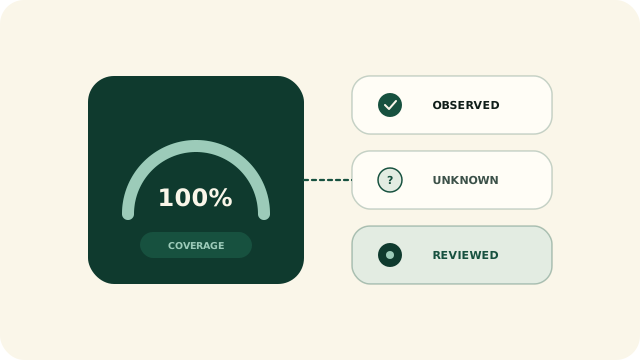
At a glance · Black-Box Dashboards · Partial API Exports
- A dashboard that shows “$0 at risk” while an API sync is only 45% complete is worse than no dashboard at all.
- Return Owl refuses Case, Returns, and Accountant Pack exports (HTTP 409) whenever the active evidence generation is incomplete.
- Every case dossier separates Observed facts (confirmed by Shopify), an explicit Unknown statement, and the merchant Review outcome — never black-box scores.
Why financial professionals distrust “smart” ecommerce dashboards
Many ecommerce apps try to impress merchants with opaque “risk scores” or aggregate trend charts that claim to spot anomalies automatically. When a merchant hands those screenshots to an accountant or auditor, the accountant immediately asks three questions: What exact rule flagged this order? Were 100% of orders in the period actually scanned? And what could explain this gap outside Shopify?
If the software cannot answer all three questions deterministically, the accountant has to throw the report away and start over from raw data.
Generation coverage gates and the three-part case ledger
The HTTP 409 Coverage Gate: why we refuse to export partial data
Shopify stores with thousands of orders and deep return histories require paginated reads across orders, returns, refunds, transactions, and products. If a network hiccup or rate limit interrupts a child read on even a handful of orders, a naive tool still lets you click “Export CSV” — handing your bookkeeper an incomplete ledger disguised as a full month-end report.
Return Owl treats coverage as a hard financial invariant. Every screen displays the exact share of orders scanned in the active generation. If coverage is below 100% — or if a refresh failed before promotion — Case queue CSVs, Returns analysis exports, and Accountant Packs refuse the download with HTTP 409 until a complete generation is promoted.
Observed, Unknown, and Review: the anatomy of a defensible case
- Observed (Confirmed by Shopify): The exact transaction status, decimal amount, currency, return-line quantity, restock type, and timestamp read from Shopify.
- Unknown (Explicitly stated): What the API record cannot prove — such as whether a customer was refunded via an off-platform bank wire, whether a physical box arrived at a warehouse without a scan, or whether a regional bank holiday delayed a 2-business-day gateway settlement.
- Review (Traceable merchant decision): Only a merchant outcome (`Refund verified successful`, `Handled in Shopify`, `Fixed in Shopify`, `Recovered value confirmed`, `Expected workflow`, `False positive`, or `Customer withdrew`) closes a case — and ROI blocks only count outcomes the merchant explicitly recorded.