
Journal · Bookkeeper & Month-End
Why Shopify returns and refunds don’t match your books at month-end (and how to close in 15 minutes)
Returns, refunds, and restocks run on three different clocks inside Shopify. Here is the 15-minute month-end workflow merchants and ecommerce bookkeepers use to reconcile them without back-and-forth Slack threads.
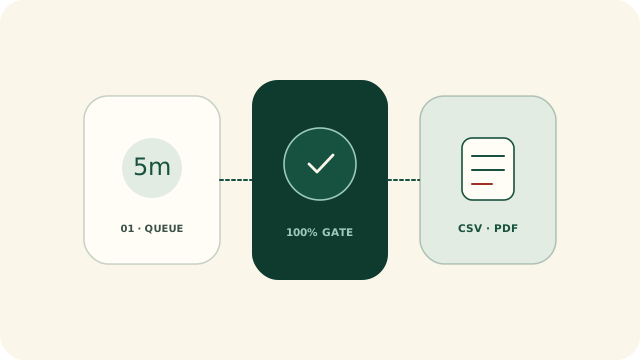
At a glance · Month-End Close · Ecommerce Bookkeepers & Fractional CFOs
- Shopify records return closure, refund settlement, and physical restock on three different clocks — so freezing a raw CSV on the 1st of the month always produces false discrepancies.
- Your bookkeeper does not need another app login; they need one coverage-gated CSV or PDF where open money risk, expected workflows, and data-integrity anomalies are separated.
- With Return Owl, store ops clears the Needs attention queue in 5 minutes and exports a signed Accountant Pack that lets the bookkeeper tie out returns in 10 minutes.
Why month-end is painful for high-return Shopify brands and their bookkeepers
Ask any ecommerce bookkeeper or fractional CFO what slows down the monthly close for an apparel or home goods brand, and returns are always near the top of the list. The merchant sends over a Shopify Sales & Returns summary; the bookkeeper compares it to the payment gateway payout feed and the ending inventory balance; and the numbers are off by hundreds or thousands of dollars.
Then begins the worst part of the month: the bookkeeper sends a list of 25 order numbers on Slack or email asking, “Was Order #1007 an exchange? Did the refund on #1039 actually go through? Did the warehouse restock #1042?” Operations spends half a day clicking through Shopify Admin to answer questions the software should have answered automatically.
How store operations and external bookkeepers divide the month-end close
The 3 numbers every ecommerce accountant needs separated
To close the month accurately without over-accruing liabilities or misstating inventory, an accountant needs return and refund exceptions bucketed into three non-overlapping totals in the shop’s accounting currency:
- 01
1. Open Money at Risk (NEEDS_ATTENTION — $422.40 in sample store)
Unresolved failed refunds, pending gateway stalls, canceled orders retaining payment, closed returns with refunds owed, prorated refund discrepancies, and un-restocked shippable refunds. These are the actionable items to either fix in Shopify before cutoff or accrue as month-end exceptions.
- 02
2. Expected Operational Workflows (EXPECTED — $160.00 in sample store)
Exchanges, store-credit refunds, instant refunds, keep-it/damaged policies, manual gateways, cancellation fees, and intentional NO_RESTOCK lines. Documented row-by-row so the bookkeeper sees why cash or stock did not move without treating them as errors.
- 03
3. Return-Record Integrity (DATA_INTEGRITY — $0.00 risk)
Impossible return-line quantities isolated outside the money totals so corrupt 3PL/WMS sync records never distort financial figures.
What is inside the Return Owl Accountant Pack
| Pack field / guarantee | What it states | Why your accountant cares |
|---|---|---|
| Order & Case Reference | Exact Shopify order number (#1039), date, case ID (RO-2046), and subject | Ties every row directly to the underlying commercial document |
| Class & Expected Workflow | NEEDS_ATTENTION, EXPECTED (with workflow name), or DATA_INTEGRITY | Eliminates the “was this an exchange or a mistake?” email thread |
| Restock Disposition & State | Whether restock was expected (RETURN), intentional (NO_RESTOCK), or completed | Supports inventory valuation and COGS adjustments at month-end |
| Exact Per-Currency Decimal Amount | Strict decimal strings in the shop currency; never floating-point or cross-currency sums | Matches accounting ledger precision with zero rounding drift |
| Actor & 100% Coverage Gate | Acting Shopify staff display name/ID plus active generation coverage verification | Proves who reviewed the exception and guarantees the file is not from a partial scan |